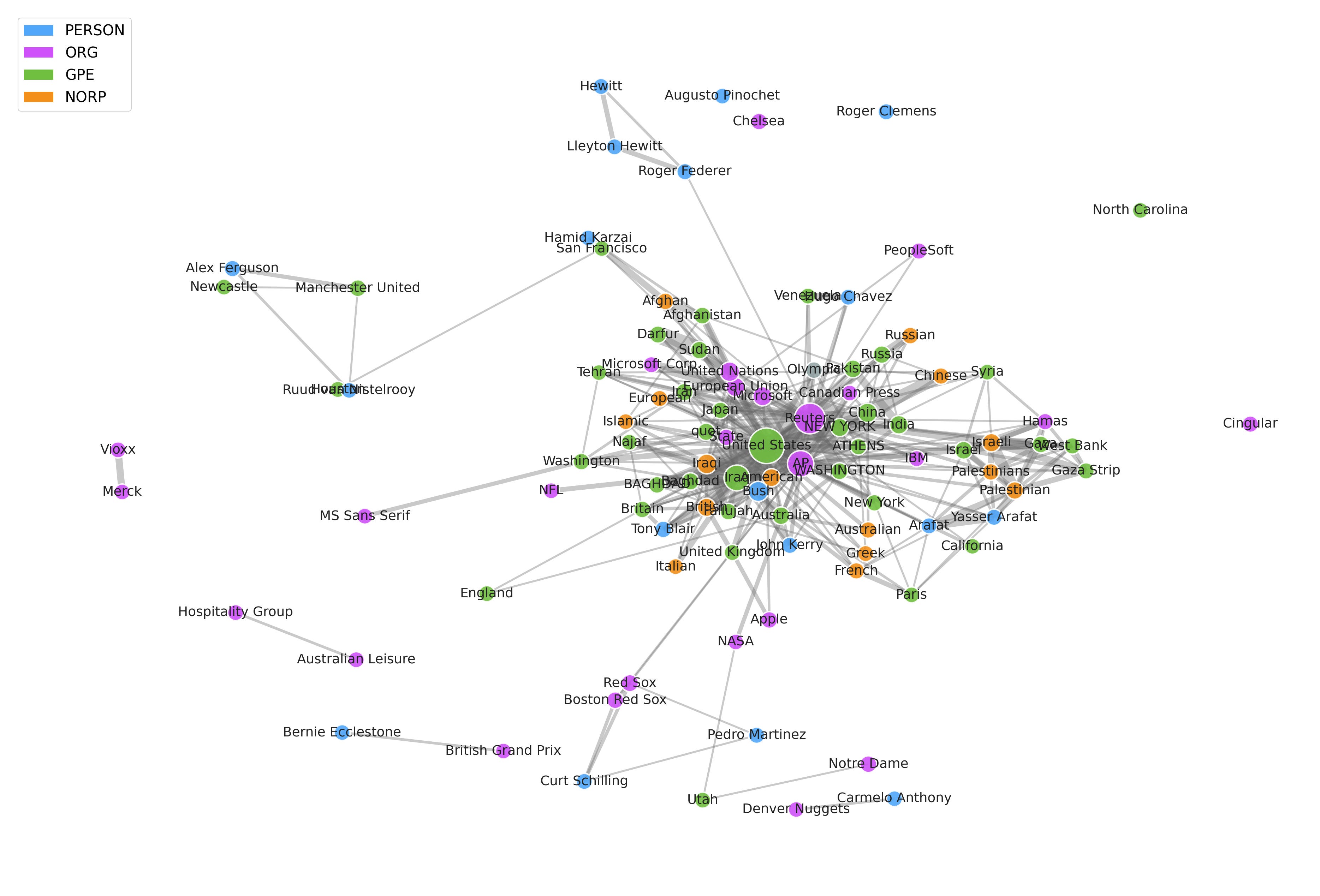
Ever wonder how we can turn thousands of unstructured news articles into structured, actionable insights?
In the latest post from Data4Sci, we dive into the fascinating process of transforming raw text from news articles into interconnected networks of information. If you're interested in Natural Language Processing (NLP), entity extraction, and how to connect the dots hidden across massive amounts of unstructured data, this is a must-read!
On the research side, a new approach called δ-mem cuts the cost of online memory for large language models. Retrieval is getting a rethink too. One paper argues that search agents should interact with the corpus directly rather than rely on semantic similarity. Another sketches what a superintelligent retrieval agent might look like as the next step for information retrieval. Prompting research also got a useful check, with fresh work on baselines and metrics for counterfactual prompting, so claims about prompt tricks can be tested properly.
Data shows that the best way for a newsletter to grow is by word of mouth, so if you think one of your friends or colleagues would enjoy this newsletter, go ahead and forward this email to them. This will help us spread the word!
Semper discentes,
The D4S Team
"LLMs in Production: From Language Models to Successful Products" by C. Brousseau and M. Sharp is for data scientists and machine learning engineers who have moved past the “cool demo” phase and now need to ship something people can use. The book focuses on the real work behind LLM products: choosing models, preparing data, building RAG systems, evaluating outputs, controlling cost, managing latency, and deploying reliably.
Its biggest strength is that it treats LLMs as production software, not magic. The authors connect familiar ML concerns—measurement, data quality, feedback loops, monitoring, and trade-offs—to newer LLM-specific patterns such as prompt design, fine-tuning, LoRA, RLHF, hosted APIs, Kubernetes deployment, and edge inference. The hands-on projects help ground the material, especially for readers who want more than another conceptual overview.
The book is not perfect. Some sections move quickly, and experienced MLOps engineers may wish for more depth on architecture, observability, or failure analysis. Its tooling choices may also date quickly, as LLM infrastructure continues to shift. Still, the core value holds: this is a practical guide to thinking like an engineer when working with language models. For anyone trying to turn LLM experiments into durable products, it is an easy book to justify buying.