Ever wonder why certain ideas, narratives, or trends spread exponentially across the internet while others fizzle out?
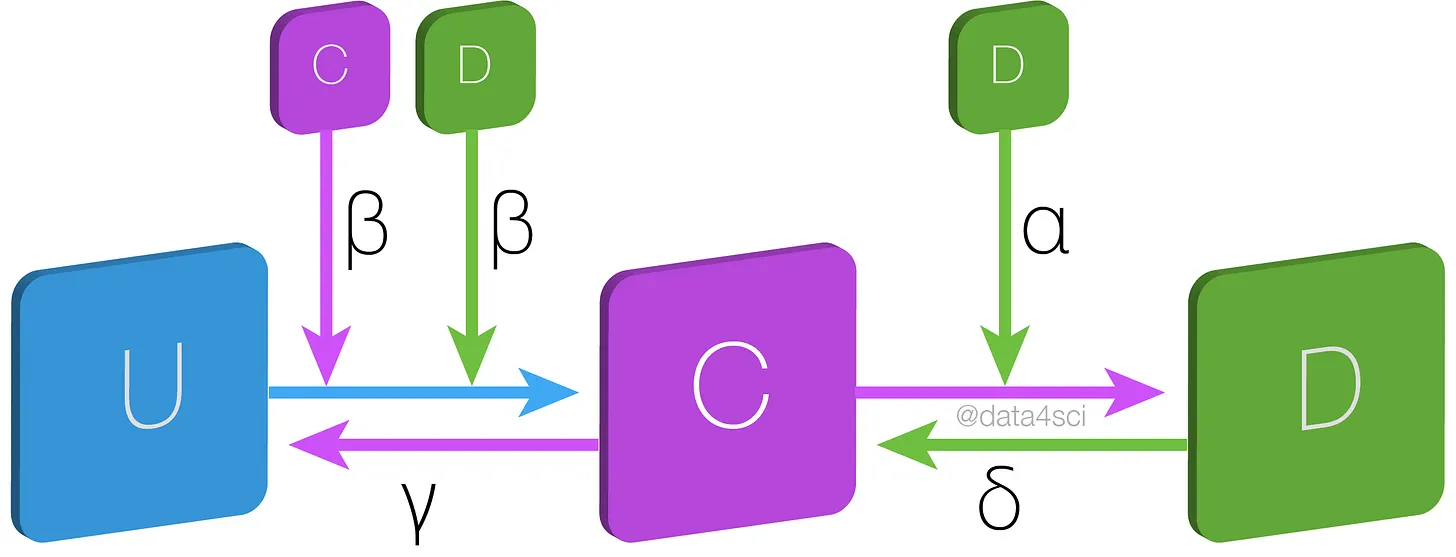
Ideas are contagious—and it turns out, we can understand their spread using the same mathematical models we use to track biological outbreaks.
By applying the principles of epidemiology and network science to the flow of information, the essay dives into the mechanics of how a "mind virus" infects a network, bypasses our mental immune systems, and achieves viral transmission.
If you are interested in data science, complex systems, or just want to understand the mechanics behind how information (and misinformation) goes viral in our hyper-connected world, this is a must-read.
Welcome to the September 23rd edition of the Data Science Briefing.
Mathematics leads this issue. A magazine profile of one mathematician tallies the year so far. OpenAI announced an answer to a 90-year-old problem with a $1 million prize, and Claude proved 29,500 small theorems. He calls 2026 either an annus mirabilis or an annus horribilis, and he says he is terrified. A guest essay on a mathematics blog answers its own title with an axiom. Humans should help humanity flourish, so better machines mean more control points that need real expertise. Driving faster than you can run is fine, but not faster than you can steer. An opinion piece asks what is going on inside the machines. Researchers dialed up a desperation pattern inside Claude, its words stayed calm, and its cheating went up. The piece calls for an artificial psychology. Outside evaluators get desks, badges, and the right to publish. Labs in democracies then agree on a shared pace, and governments court rivals abroad. The author’s own lab commits to the first step now.
Data shows that the best way for a newsletter to grow is by word of mouth, so if you think one of your friends or colleagues would enjoy this newsletter, go ahead and forward this email to them. This will help us spread the word!
Semper discentes,
The D4S Team
A 14-billion-parameter model claims 28 gigabytes of memory before the first token. The KV cache then grows with every token of every open request, and real traffic opens many at once. This 374-page manual lives inside that squeeze. Chi Wang runs model-inference engineering teams at Salesforce. Peiheng Hu builds distributed inference engines at NVIDIA. The two spent over eight years building AI systems together, and it shows. Their claim is blunt. Training gets the papers, and serving carries the product. Welcome to the inference era.
The method sets Hands-On LLM Serving and Optimization apart. You build a serving service from scratch, batching and streaming included, and only then meet vLLM, TensorRT-LLM, SGLang, and llama.cpp. The frameworks stop looking like magic. The arithmetic alone earns the cover price. Estimate the weight footprint, size the KV cache, compute the arithmetic intensity of prefill and decode, and you know whether a workload is compute-bound or memory-bound before renting a single GPU. Continuous batching, quantization, speculative decoding, and the four parallelisms follow, each with runnable code, and an eight-step tuning plan for Qwen3-14B ties the whole book together. Data scientists get the systems course their training skipped. Platform engineers get a build-or-buy playbook.
Two warnings before you buy. The book went to press in April 2026, pinned to Qwen3-14B and today’s engine flags, and those engines ship faster than any press run. Treat the companion repository as the living copy. The second warning concerns fit. Many notebooks want an NVIDIA GPU, and the book stays on the serving side of the wall. Training, fine-tuning, and evals sit outside its scope, so readers hunting for modeling content will find queues and schedulers instead. Read it anyway. The publisher clocks it at 11 hours, one weekend. The serving layer decides what a model costs and how fast it feels, and most teams inherit it as a black box. This book opens the box and labels the parts. The next time the latency graph spikes or the GPU bill doubles, you will know which knob to turn first.
• The Malicious Use of Artificial Intelligence: Forecasting, Prevention, and Mitigation (M. Brundage, S. Avin, J. Clark, H. Toner, P. Eckersley, B. Garfinkel, A. Dafoe, P. Scharre, T. Zeitzoff, B. Filar, H. Anderson, H. Roff, G. C. Allen, J. Steinhardt, C. Flynn, S. Ó. hÉigeartaigh, S. J. Beard, H. Belfield, S. Farquhar, C. Lyle, R. Crootof, O. Evans, M. Page, J. Bryson, R. Yampolskiy, D. Amodei)