Announcements
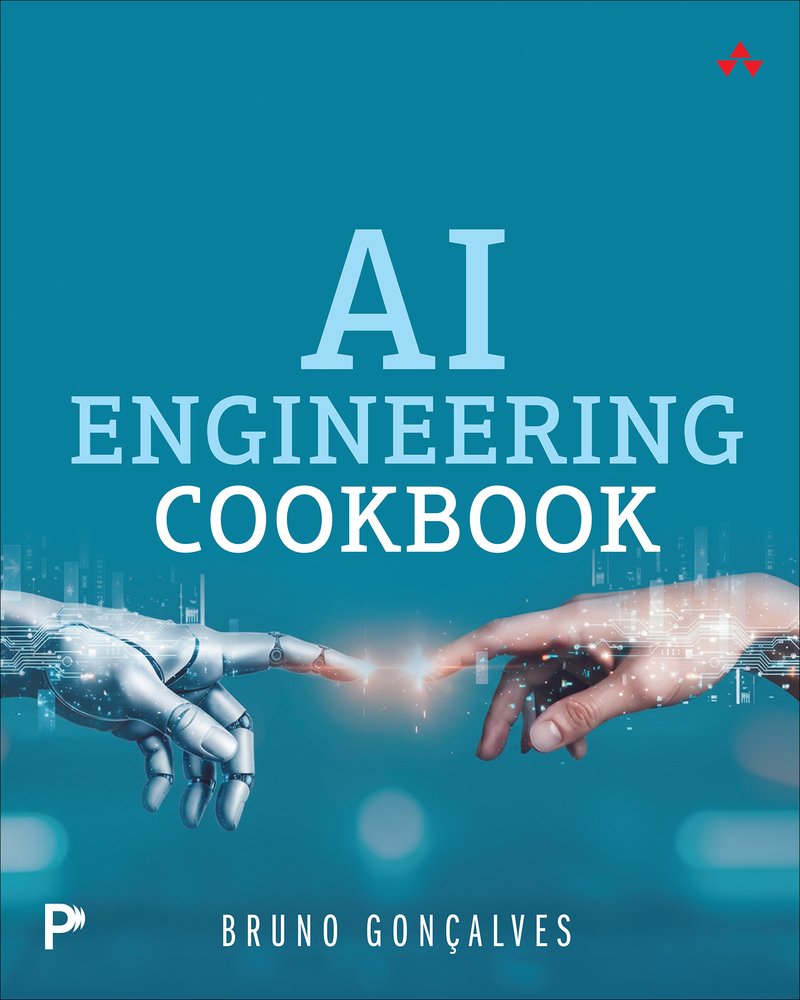
Good news, everyone! We're proud to announce that our book is coming to a bookshelf near your in 2027!
The book is split into 18 chapters and each chapter is an individual project in Python for building an AI systems that actually hold up in production. Starting from single structured LLM calls and RAG workflows to evaluation harnesses, multi-agent systems, and fine tuning self-hosted open-weights models.
As always, everything is built from the ground up to run on a modern laptop and using only publicly available datasets.
Explore the full table of contents and get notified when pre-orders open
And if you're interested in this topic, don't forget to register to the Data for Science substack where we cover how to use LLMs in detail!
Dear Reader,
Welcome to the 345th edition of the Data Science Briefing.
Coding is where AI earns its keep today, and the hard part has moved from writing code to checking it. The Claude Code team says Claude now writes and reviews about 90 percent of the team’s code. Nobody reads every line. A commit gate blocks unverified changes. A 39-item checklist runs only the 3 to 10 items that match each change. The code reviewer reads its rules from the base branch, so a pull request cannot rewrite its own checks. The post puts the rule in one line. “If a change can modify the check that judges it, the check is broken.” The wrapper around the model matters just as much. A new benchmark ran 22 coding-agent harnesses with 5 open models on 62 terminal tasks, for 27,280 runs in all. A harness is the software that wraps a model and runs its tool calls. No harness wins everywhere. Codex CLI posts the lowest cost per pass with GLM-5.3, at $0.803, and drops to 16th place with Kimi-K3. The median harness moves 11 of 22 places from one model to the next. Model choice explains 92.8 percent of the differences in cost. The money behind all this is less certain. Anthropic plans a stock listing at about $1.5 trillion. That price puts it among the 15 largest public companies in the world. AI revenue runs at about $200 billion a year. The data-center buildout needs about $3 trillion in revenue by 2030 to earn a normal return. So far, software engineering is the only industry AI has upended. The rest of the economy has to follow.
Small design choices still decide what a model does. A long explainer walks through how language models track word order. GPT-2 learns a fixed table of 1,024 positions. Rotary embeddings turn each query and key by an angle tied to its position. The attention score then depends on the gap between two tokens, not on where they sit. Among models with rotary embeddings, a partial version that rotates only some dimensions went from a minority in 2025 to a majority in 2026. The author calls it “hardly worth it.” A recommender faces a different choice. It has to decide what to show next. A data-series post treats 12 popular movies as a row of slot machines. Over 12,000 interactions, a plain epsilon-greedy policy reaches a high-rating rate of 0.8826. Random picks reach 0.7905. How a system chooses what to show matters, not only how well it predicts. Readers now face a harder version of that choice. AI makes a book-length text almost free to produce. Scam titles crowd in next to real ones in online stores. One reader came to an author with a claim a chatbot had made up about the author’s book. Code gets a test suite. A reader gets a cover and a blurb, and each fake title wears down the trust between writers and readers.
What a model learns depends on what it sees. A popular claim says reinforcement learning (RL) generalizes and supervised fine-tuning (SFT) memorizes. A new paper traces much of that gap to the SFT data. A carefully mixed dataset beats one written by a single larger model. Matching the total rollout budget lets SFT match RL on generalization. Combining both fixes puts SFT ahead. Larger datasets cover more rare ways of solving a problem, and those rare paths carry the signal that transfers. Distillation gains from a wider view too. A small student usually copies a teacher’s predictions on the training text. Here both models first read perturbed text, with token noise or blended documents. Training then switches back to clean text. For a 135M student, the extra improvement is 1.45 times the gain distillation gives over plain next-token training. With added noise, most of that gain comes from perturbing the teacher’s input. Tables can skip real data entirely. A new family of tabular foundation models trains only on synthetic tables drawn from structural causal models. The largest model sees more than 100 million of them. It predicts new rows in one forward pass, with no per-dataset training. It ranks first on a major public leaderboard with an Elo of 1,950 and runs 17 times faster than LimiX-2.
Some of the best fixes come from another field. A 2023 serving paper borrowed virtual memory from operating systems. It splits each request’s key-value cache into fixed-size blocks that need not sit together in memory. Older systems put as little as 20.4 percent of that memory to real use. The new design wastes almost none and lifts throughput 2 to 4 times at the same latency. Network epidemiology puts methods from several traditions head to head. Seven ways to find patient zero, from Steiner trees to a graph neural network, face eight temporal contact networks under one problem setup. Loopy belief propagation and the graph neural network beat the rest across network types and epidemic settings. Complex systems suit research driven by AI agents, a new essay argues. These agents pair language models with tools and repeated runs. But most simulators hide their controls and outputs from text-based agents. The essay calls for agent-friendly interfaces on these models. Academia discourages exactly this kind of risky work, a 57-author paper argues. Short grants, output metrics, and insecure contracts push early-career researchers toward safe projects. Strategic conformity becomes the rational choice. The authors ask for more varied grant cycles, room to fail, and less weight on narrow metrics.
Our latest book recommendation is “Co-Existence: The Next Phase of AI” by E. Mollick. In this week’s video, we have an OpenAI Decisions API Full Tutorial for beginners.
Data shows that the best way for a newsletter to grow is by word of mouth, so if you think one of your friends or colleagues would enjoy this newsletter, go ahead and forward this email to them. This will help us spread the word!
Semper discentes,
The D4S Team
This weeks book is "Co-Existence: The Next Phase of AI" by Ethan Mollick. In 2022, forecasters gave AI a 2.3% chance of Math Olympiad gold by 2025. Google and OpenAI both won gold in 2025. Ethan Mollick builds his new book on that miss. The Wharton professor’s sequel to Co-Intelligence runs 240 pages. Its subject is daily life beside smart but erratic machines. Mollick writes for general readers, but model builders will find plenty worth stealing.
Chapter 3 explains the jagged frontier with two ideas. Emergence means one fixed weak link brings a sudden jump in skill. Transcendence means a model trained on many people beats each of them. Both terms help with managers who expect smooth progress. The Bitter Lesson section shows GPT-4 beating the finance-trained BloombergGPT on financial tasks. Any team pricing a custom domain model should read it. The book swaps prompt tricks for context engineering. In one negotiation study, instruction differences explained 73% of the variation in outcomes. Chapter 7 brings the O-Ring theory to AI at work. Speed up one link, and the bottleneck moves. One early 2025 study found 75% of engineers using AI tools, with zero correlation to deployment frequency. Chapter 10 shows models misreporting their own reasoning. A model’s self-report is a lead, not a fact.
The chapters on work speak to anyone who ships models. Mollick keeps his Centaur and Cyborg modes from the first book. He adds a third mode, the Conjurer. You hand an agent a whole project and judge the output. The book skips the setup work behind that judgment. Eval sets and test harnesses take weeks to build. Data scientists do that work every day, and the book leaves that chapter to them. Skim Chapter 3. Read Chapter 7 ahead of your next planning meeting. Then ask where your team’s weakest link sits.
Opportunities to learn from us.