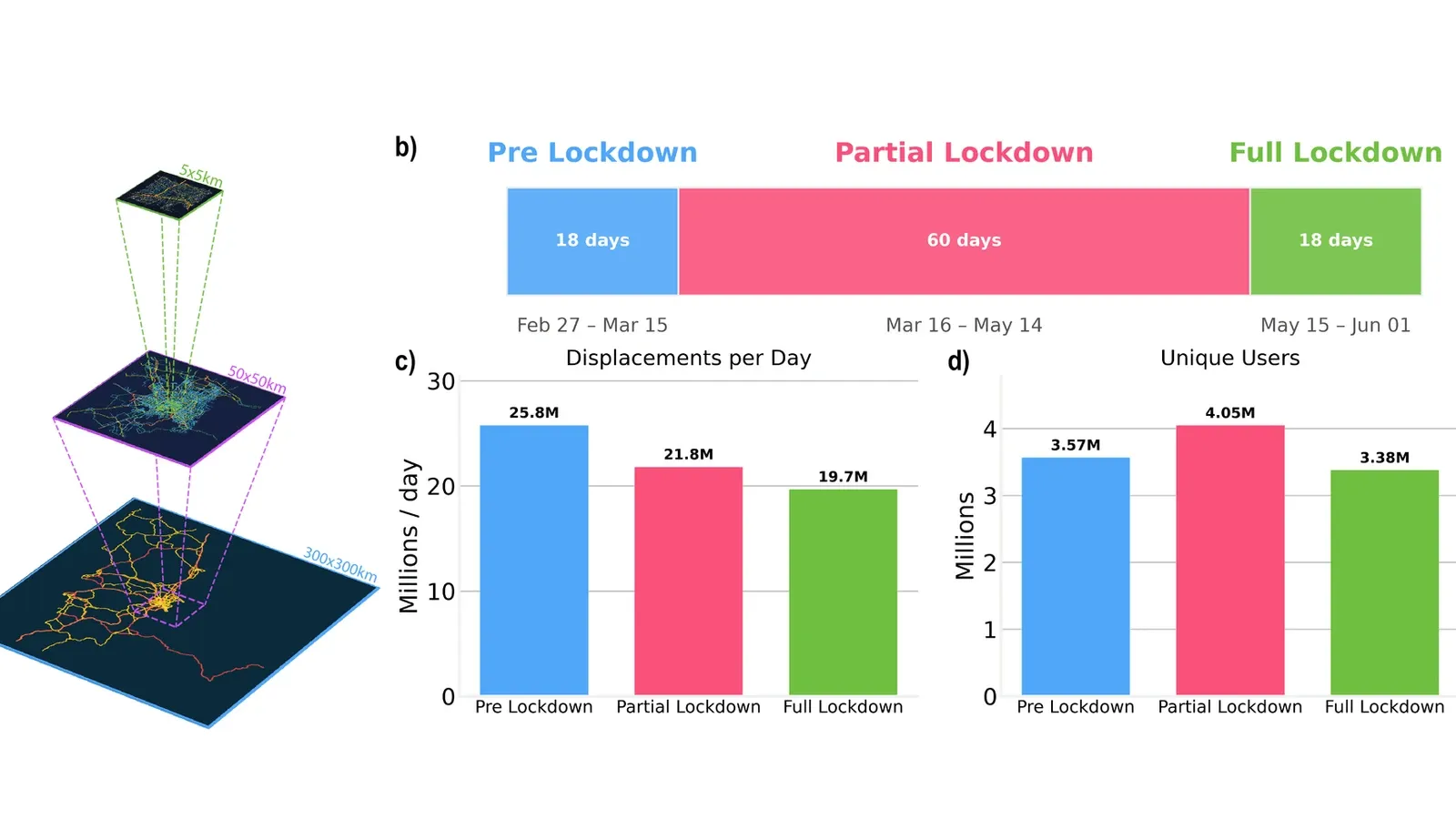
For nearly two decades, human travel has been described as scale-free, with the same statistical pattern from a walk around the block to a long-haul flight. A new preprint by Leo Ferres and Bruno Gonçalves argues that this pattern is an artifact of how the data gets pooled.
The test was a natural experiment: COVID-19 lockdowns in Chile, tracked through 2.1 billion trips from 4.4M anonymized phone users. Lockdowns removed long-range travel but left local trips mostly intact. Once that happened, individual movement was clearly lognormal. Combining lognormals from neighborhood, city and regional “containers” reproduces the aggregate curve.
Welcome to the Oct 21st edition of the Data Science Briefing.
Machines now take on real work, and people still check it. Claude worked inside six drug programs, and on 1,061 pages of manufacturing records it caught every problem human reviewers found, plus 7 more . Claude Duet, a research preview, sends a morning brief and needs your approval to pay a bill. So what does an engineer still need to know? Fundamentals, breadth, and the will to dig deep, one engineer answers. His agent had packed 15 components into a file of about 30 lines. A model’s stated confidence deserves the same doubt. Ask twice, and it can answer 0.85 and then 0.7, so build the score from observed signals and logged outcomes instead. The data series supplies the fundamentals. A GRU with attention translates English to German at 0.315 token accuracy. A small transformer reaches a validation loss of 2.8717 on WikiText-2 characters. A convolutional network names five pet breeds at 91.0 percent on synthetic stand-in data, and a U-Net marks the animal’s pixels. The last two links ask what survives a network outage. Survival LLM runs a local model over about 930,000 offline Wikipedia articles and cites every answer. The web itself forgets, and publishers now block its biggest archive over AI training fears. The block will not stop AI companies, the archive’s founder argues, and the public loses its record. Someone still has to check the work, and someone has to keep the copy.
Our latest book recommendation is “Build with Claude Code” by T. Jo. In this week’s video, we have a video by Richard Feynman answering the question: Can Machines Think?
Data shows that the best way for a newsletter to grow is by word of mouth, so if you think one of your friends or colleagues would enjoy this newsletter, go ahead and forward this email to them. This will help us spread the word!
Semper discentes,
The D4S Team
"Build with Claude Code" by T. Jo: 9 projects, 408 pages, and you write none of the code. You describe each program in plain English. Claude Code does all of the typing. The author, Taeho Jo, studies early Alzheimer’s diagnosis with deep learning at the Indiana University School of Medicine. Packt published this English edition of his Korean original on August 31, 2026. Each project is bigger than the last one. They run from a single webpage to a database-backed shopping list on Vercel and Supabase.
Why should a data scientist read a beginner’s book? The answer is deployment. Most of us stall at the notebook stage of a project. A model on a laptop serves no users at all. This book ends with a live app and a real database behind it. The middle chapters teach habits worth stealing for model work. Chapter 5 drills hallucination checks on generated quiz content. CLAUDE.md files carry project rules from one session to the next. Custom commands turn repeated chores into one-line calls. Chapter 6 covers API keys, .env files, and .gitignore entries. Chapter 7 scopes an app with the 5W1H questions. Sub-agents then build it in product, frontend, backend, and QA roles. Chapter 8 adds MCP servers, Skills, plugins, GitHub, and Playwright to the kit.
Model builders face two problems with this book. It assumes no programming background from its readers. Part 1 spends four chapters on AI history, prompt basics, installation, and a to-do app. An ML engineer will clear that half in an hour. The bigger gap sits in the machine learning content itself. Only one project builds a model, a handwriting recognizer on the MNIST digits. No chapter title mentions notebooks, data pipelines, evaluation, or model serving. Claude Code ships new releases most weeks. The printed screenshots will age within months. So skim Part 1 in a single evening. Give Part 2 a full weekend at the keyboard. Data scientists rarely lack models, only the plumbing around them. Your last model still sits on your laptop. After Chapter 8, point Claude Code at it.