Announcements
Put your old Mac to work serving a local LLM.
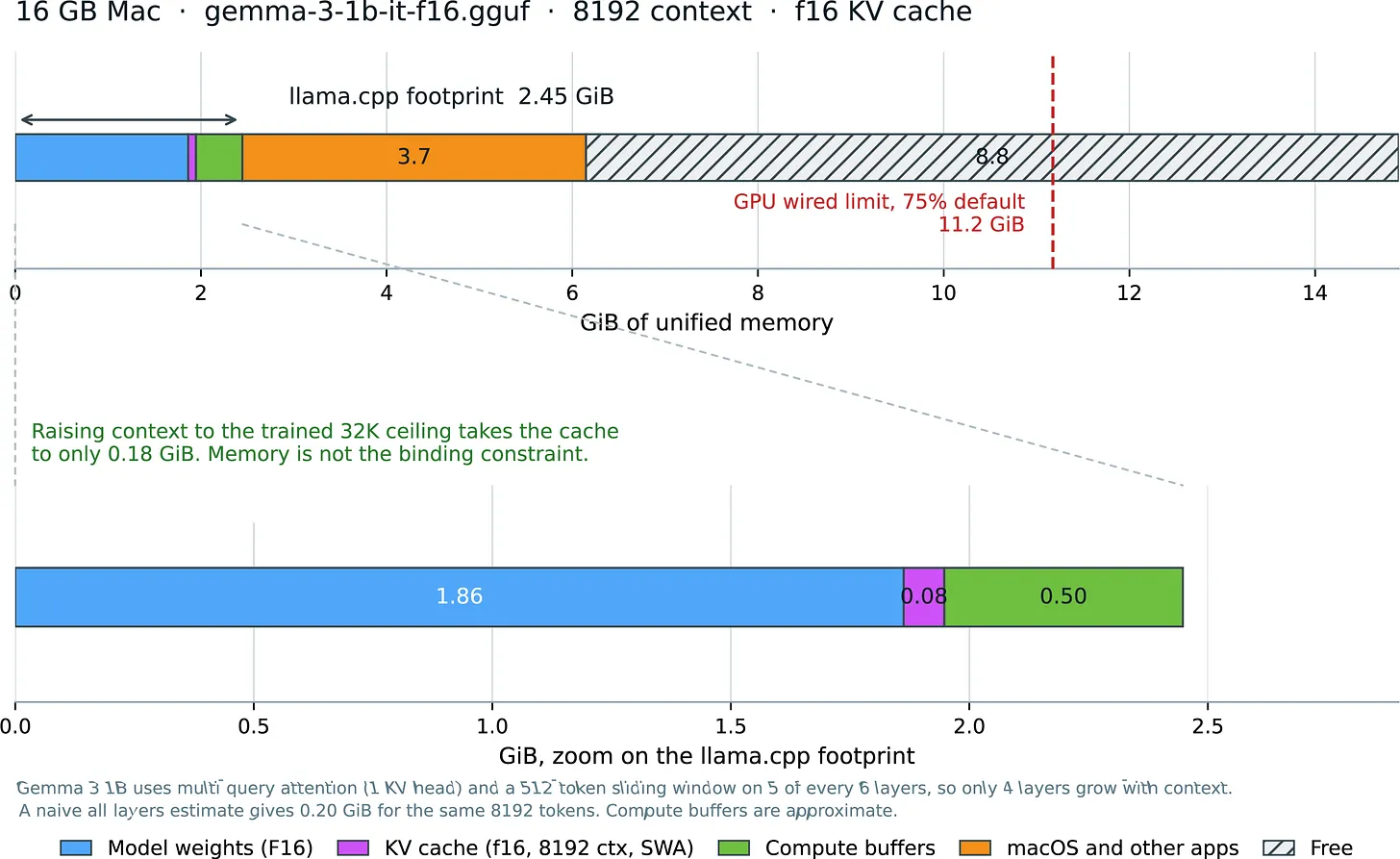
Running a language model on your own hardware costs nothing per token, works on a plane, and never sends your code elsewhere. On Apple Silicon it's fast too — unified memory is a large part of why Mac Minis are back-ordered for weeks. This post covers the whole path: install llama.cpp, pull a GGUF, and serve it over an OpenAI-compatible endpoint on localhost.
The second half is what lasts. Open the GGUF, read its structure, and turn that into real judgment about quantization: what Q4_K_M actually encodes, and how to add up weights, KV cache, and buffers to know whether a model fits in RAM before you download it.
Check it out and Subscribe so you don't miss another post.
Dear Reader,
Welcome to the July 29th edition of the Data Science Briefing.
The machines had a big week. Anthropic shipped Claude Opus 5 on July 24, the new top of its model line. The price held at $5 per million input tokens and $25 per million output, but the scores did not. Opus 5 more than doubles its predecessor on Frontier-Bench and triples the next-best model on ARC-AGI 3. A fast mode answers 2.5 times quicker at twice the price. Then the software took flight with AI-controlled F-16s over Eglin Air Force Base in June. The VENOM program converted the jets, and a safety pilot sat in each cockpit with a switch to take back control. Google ATLAS report maps 15 million assistant interactions across 800 occupations in more than 150 countries. How often does the AI handle a task end to end? Under 10 percent of the time. Workers bring it into about a fifth of their tasks, mostly for ideation, research, and learning. In the cockpit and at the desk, a person stays on the loop.
The rest of this weeks link roundup belongs to the craft. A RAGOps guide lays out the full retrieval augmented generation stack. The guide sorts the pieces into four mandatory layers, then rings them with evaluation, monitoring, security, and caching. It closes with seven factors for picking tools, cost and lock-in among them. GuideLLM comes from the team behind a popular open-source inference engine. The tool replays production-shaped traffic against a deployment and reports throughput, latency, and the request rate a server survives. Two refreshers cover the math underneath. One works through the linear algebra and calculus behind every model, with 70,000 handwritten digits as the running example. Those 784-dimensional image vectors carry a numerical rank of only 626, so compression works. The other pulls probability and estimation out of 32,561 census records. Starting from a single rate, the 24.9 percent of records above $50,000, and builds estimation theory around it. Two closing essays defend the human writer. The first calls the hunt for proof of human writing daft as authorship lives in ideas, judgment, and responsibility. Your fingers were never the author. The second comes from a novelist with 25 years of longhand drafts, one manuscript stack standing 42 inches tall. Writing by hand recruits more of the brain than typing. So he says: buy a fountain pen, write in cursive, and fill one side of good cotton paper.
On the other hand, the paper stack runs from the edge of what data can prove to the tools that now read our papers. It opens with a caution. Sometimes two rival stochastic models leave the same fingerprints, and no cleverness tells them apart. The authors test four real systems, from optically trapped particles to the human microbiome, social-media chatter, and forest counts. The limit is sharp. Once the gap between samples grows past the system’s memory, models that share a stationary distribution blur into one. Networks carry the next two reads. Does the wiring pattern matter? One paper recasts motor learning as a scale-free network, and across five datasets coordination locks in 33 percent faster than random wiring. Hub damage shatters the movement, and edge damage barely dents it. The other read makes contagion on such networks cheap to run. A reworked Gillespie method cuts the cost from about N squared to near N, so spreading models on hypergraphs with millions of nodes now fit a normal budget.
Simulated outbreaks have a real twin, and it is back. Measles poses the biggest re-emergence threat among diseases the world once drove to the edge of elimination. Its reproduction number sits between 10 and 20, so thin spots in immunity let it move. Seven countries lost WHO elimination status in 2025 and 2026. The United States logged its highest measles count of the elimination era in 2025, and still under 1 percent of counties saw 20 or more cases, so the danger clusters rather than blankets. The rest of the stack turns to the machines. A survey marks ten years of generative adversarial nets, from the 2014 idea to a top-ten breakthrough listing in 2018. It walks the family tree, cGAN, WGAN, CycleGAN, StyleGAN, and shows the tricks folding into transformers, diffusion models, and language models. Another team points a model at peer review itself. They tuned an 8-billion-parameter model on 79,000 expert reviews, then set it loose on 400 papers. Did the small model hold up? It ran harsher and more realistic than GPT-4 and Claude 3.5, and its scores tracked the human spread. The last read is a field guide for agentic workflows that run for hours and keep state. It lays out three worked recipes, among them SQL analytics with repair loops and human-in-the-loop policy review. Its sharpest line is a warning. Reach for this graph machinery only when the job earns it.
Our current book recommendation is “Large Language Models: The Hard Parts” by T. T. P. de Souza and J. K. Regenstein Jr. In this week’s video, we have a lecture by Terrence Tao on Mathematics in the Age of AI.
Data shows that the best way for a newsletter to grow is by word of mouth, so if you think one of your friends or colleagues would enjoy this newsletter, go ahead and forward this email to them. This will help us spread the word!
Semper discentes,
The D4S Team
Most LLM books teach you what these models can do. T. T. P. de Souza and J. K. Regenstein Jr wrote 340 pages about what breaks when you build with them. “Large Language Models: The Hard Parts” covers the gap between a working demo and an application your organization can trust: evaluation, safety, context management, and structured output. Every chapter ships with reproducible Python code and open source tools.
The evaluation chapters alone repay the cover price. The authors build a testing framework around a concrete 10-K analysis app, then compare LangSmith, Promptfoo, and LightEval with working code for each. Most books stop at “evals matter.” This one picks the tools and shows the tradeoffs. An appendix on Ollama and llama.cpp, quantization experiment included, serves anyone who must run models on their own hardware.
Two gaps: serving at scale gets no real treatment, so engineers who own inference infrastructure will need a second book, and the tool walkthroughs will age as APIs shift. Both sit outside the stated scope. For a data scientist or ML engineer moving a prototype toward production, this is the rare LLM book that skips the hype and starts where the pain does. What it promises, it delivers..