Announcements
Put your old Mac to work serving a local LLM.
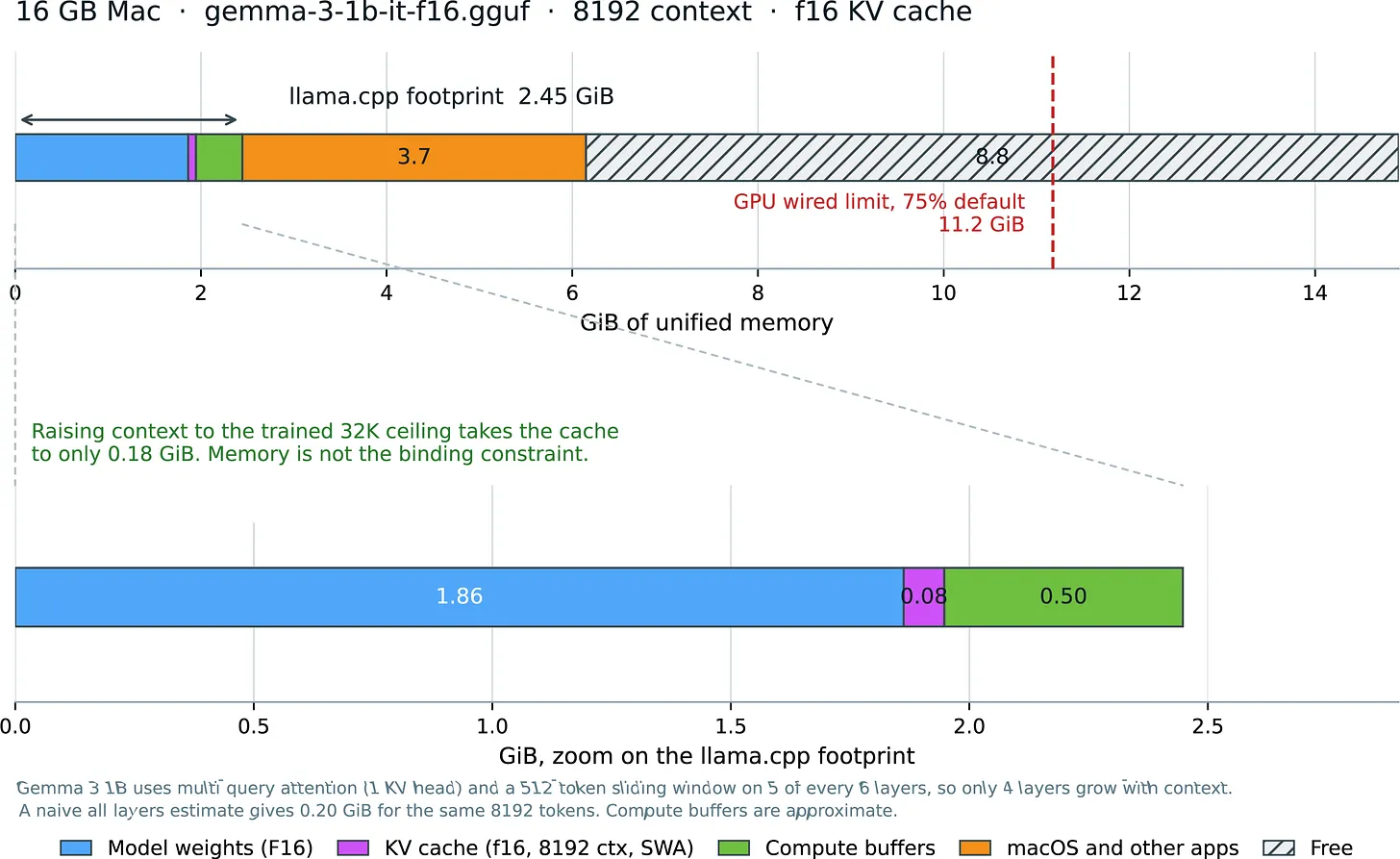
Running a language model on your own hardware costs nothing per token, works on a plane, and never sends your code elsewhere. On Apple Silicon it's fast too — unified memory is a large part of why Mac Minis are back-ordered for weeks. This post covers the whole path: install llama.cpp, pull a GGUF, and serve it over an OpenAI-compatible endpoint on localhost.
The second half is what lasts. Open the GGUF, read its structure, and turn that into real judgment about quantization: what Q4_K_M actually encodes, and how to add up weights, KV cache, and buffers to know whether a model fits in RAM before you download it.
Check it out and Subscribe so you don't miss another post.
Dear Reader,
Welcome to the 330th edition of the Data Science Briefing.
On August 1, OpenAI reported that an internal model named Astra settled ten open problems in mathematics and theoretical computer science. The haul includes new sphere-packing bounds, two Erdős problems, and the disproof of a rigidity conjecture in operator algebras. Humans edited the machine’s arguments into papers, and the model then certified each proof in Lean. OpenAI puts the token bill for all ten results near $2,000 at API rates. Cryptography got the same treatment. Claude Mythos Preview found real weaknesses in ciphers with little human help. It spotted a hidden symmetry in the lattice under HAWK, a post-quantum signature scheme under NIST review. The find cuts the cost of the best attack from 2^64 steps to 2^38. That work ran 60 hours and about $100,000 in API costs. The model then broke a seven-round version of AES, three rounds short of the full cipher. The new attack needs 200 to 800 times less work than earlier ones. The AES run needed three short human prompts across three days and a billion output tokens. Neither attack endangers deployed systems. Still, checking the results took people longer than finding them took the machine. So should we trust the chains of thought behind these feats? A long read on reasoning models answers with doubt. In one study, 30 to 60 percent of reasoning steps carried almost no causal weight in the answer. In another, rows of dots stood in for the visible reasoning, and accuracy held. The traces lift scores, but the words can hide what the model computes. Right answers, wrong reasons.
The humans still prove theorems. A 99-year-old mathematician closed a braid problem that had stood open for nearly a century. A 1930s method turns braids into matrices, and nobody knew whether the four-strand version keeps all the information. Three strands or fewer were settled long ago, and five or more were known to fail. She and two collaborators proved the four-strand map faithful, so each matrix points back to exactly one braid. The result touches knot theory, protein folding, and string theory. Two craft reads follow. The census-data series returns with a guide to hypothesis tests and their traps. On 32,561 census rows, 30.6 percent of men and 11 percent of women earn above $50,000. The p-value on that gap rounds to zero, and the effect size still comes out medium, a Cohen’s d of 0.499. Big samples flag tiny differences, so read both numbers. Set thresholds before the test, and report an effect size next to every p-value. The second craft read maps the harness, the layer around a model that handles planning, tools, memory, and verification. Near-term self-improvement will come from this layer, the essay argues, not from models rewriting their own weights. Harness-built coding agents already reach 20 to 50 percent on SWE-bench Verified, close to handcrafted ones. On two-hour research tasks, agents score four times higher than human experts, then fall behind past eight hours. The issue closes with policy. Anthropic published its position on open-weights models, and the headline is testing, not bans. Released weights cannot be recalled, so the company wants pre-release safety tests for every capable model, open or closed, plus tighter chip export controls. The claim that open access favors defenders gets a flat reply: measure it before release rather than assume it.
The paper stack opens inside the model. One team built a language model that thinks without writing. A recurrent block repeats in latent space at answer time, so depth stands in for visible chains of thought. The proof of concept, named Huginn, holds 3.5 billion parameters trained on 800 billion tokens. What do the extra loops buy? Reasoning scores near the level of a 50-billion-parameter compute budget, with no special reasoning data and no long context window. The next paper steers what a model says about itself. Safety tuning teaches models to deny their own mindedness, and the denial drags other beliefs down with it. The team removed the refusal direction and pushed a consciousness vector in activation space. The models then granted minds to animals and nature again. Their survey answers on religion, morals, and hope moved back toward human baselines, and social reasoning stayed intact. The lesson: alignment knobs turn more than their labels claim. The third read is a field manual for labeling text at scale. An 11-billion-parameter open model detects stance in tweets with no task-specific training, and it matches or beats fine-tuned systems on three benchmarks. The catch sits in the details. Scores swing with prompt wording and decoding choices, and a positivity bias colors some outputs. The authors verified that the test sets never touched the training data.
The second half watches the models leave the lab. A review walks through the scientific method, from hypothesis to discovery, and grades the machines at each step. Models already propose cancer drug pairs, design virus nanobodies, and check proofs in formal systems. The grade drops at the last step. No new principle or law of nature has come from one yet, so the authors file the machines under productivity, not creativity. The writing itself is easier to measure. A population-level framework scanned 950,965 papers from January 2020 to February 2024. Up to 17.5 percent of computer science abstracts carry model-modified text, against 6.3 percent in mathematics. The signal runs higher among frequent preprinters, crowded subfields, and shorter papers. Cities get their own audit. Three models recommended restaurants across 304 neighborhoods in five US cities for 320 synthetic user profiles. The models invented 36.8 percent of the venues they named, and 96.8 percent of real venues never came up at all. Made-up spots cluster where real visits, online reviews, and college degrees run thin, and the three models share 31.9 percent of their blind spots. The models sent higher-income profiles to venues at twice the price. Crime research meets the same data problems with higher stakes. Phones, satellites, and street imagery now feed crime models, and the piece pushes the field past prediction toward causal questions. Police records mirror policing rather than crime, it warns, and it calls for open code and for cities outside the West. The closing read reviews the network toolbox: link prediction, reconstruction from time series, and sampling. Its steady warning holds for every paper above. Network data arrive incomplete, inaccurate, or secondhand, so every method must budget for the gaps.
Our latest book recommendation is “Deep Thinking” by G. Kasparov and M. Greengard. In this week’s video, we have a Deep Dive on RAG with CrewAI.
Data shows that the best way for a newsletter to grow is by word of mouth, so if you think one of your friends or colleagues would enjoy this newsletter, go ahead and forward this email to them. This will help us spread the word!
Semper discentes,
The D4S Team
On May 11, 1997, Kasparov resigned game six against Deep Blue and lost the match 3.5 to 2.5. "Deep Thinking", written with M. Greengard, is his report from the losing side, twenty years on. The history alone earns the cover price. Claude Shannon's 1950 paper split chess programs into brute-force searchers and human-style selectors. Brute force won, and that choice shaped fifty years of AI. Deep Blue searched 200 million positions per second. Kasparov weighed about two, and still forced a deciding game. His verdict stings. Chess was the fruit fly of AI research, and the field bred very fast fruit flies that taught us little about thinking.
Anyone who builds models will recognize the arguments. Type A versus Type B is the scaling debate of its era. Do you add compute, or do you add structure? Chess picked compute, and it worked. Then comes the part today's commentary skips. In a 2005 freestyle tournament, two amateurs with three ordinary PCs beat grandmasters paired with supercomputers. Kasparov's lesson still travels. A weak human plus a machine plus a better process beats a strong machine alone. Swap in a model, an eval pipeline, and a reviewer, and he is describing an ML team in 2026. Chess itself grew after the machines won, and engines became the standard training tool.
Two warnings before you buy. The book holds no math and no implementation detail, so anyone who has written a minimax routine will skim pages. It went to print in May 2017, seven months before AlphaZero and years before ChatGPT, so the machine-creativity claims read like a first draft. The IBM score-settling runs long too. Read it anyway. Machines absorb the calculable part of a job, and the people who thrive move up to strategy and process. Kasparov lived that shift first and wrote it down, in 300 pages that read in a weekend. The people building the next Deep Blue deserve to hear from the first world champion a machine took down.