Issue #342
October 28, 2026
Announcements
Is human mobility really a power law?
For nearly two decades, human travel has been described as scale-free, with the same statistical pattern from a walk around the block to a long-haul flight. A new preprint by Leo Ferres and Bruno Gonçalves argues that this pattern is an artifact of how the data gets pooled.
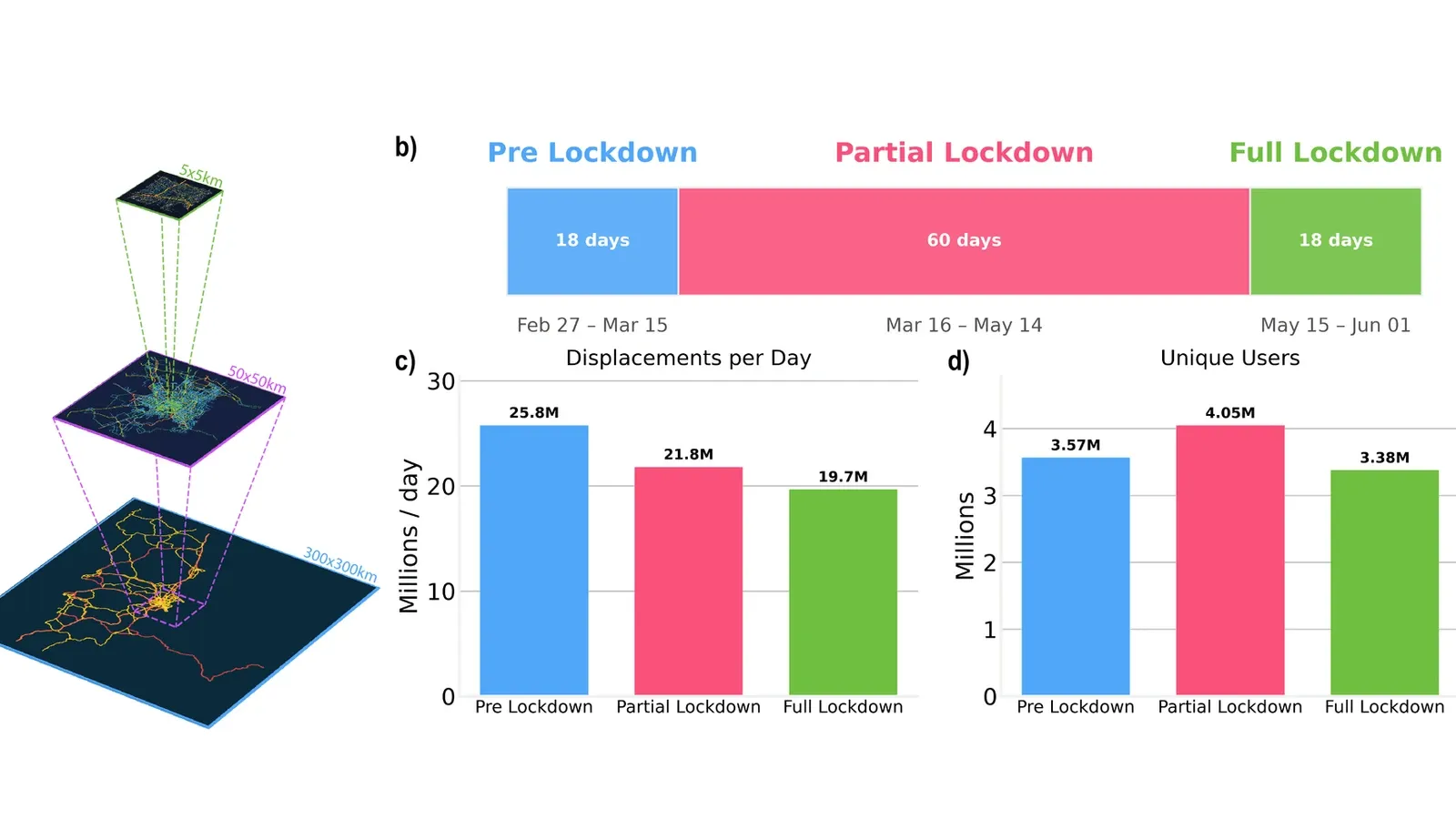
The test was a natural experiment: COVID-19 lockdowns in Chile, tracked through 2.1 billion trips from 4.4M anonymized phone users. Lockdowns removed long-range travel but left local trips mostly intact. Once that happened, individual movement was clearly lognormal. Combining lognormals from neighborhood, city and regional “containers” reproduces the aggregate curve.
Primary covered the work:
Check out the arXiv paper as well: 👉 arXiv: 2608.23194
Dear Reader,
Welcome to the Oct 21st edition of the Data Science Briefing.
Machines now take on real work, and people still check it. Claude worked inside six drug programs, and on 1,061 pages of manufacturing records it caught every problem human reviewers found, plus 7 more . Claude Duet, a research preview, sends a morning brief and needs your approval to pay a bill. So what does an engineer still need to know? Fundamentals, breadth, and the will to dig deep, one engineer answers. His agent had packed 15 components into a file of about 30 lines. A model’s stated confidence deserves the same doubt. Ask twice, and it can answer 0.85 and then 0.7, so build the score from observed signals and logged outcomes instead. The data series supplies the fundamentals. A GRU with attention translates English to German at 0.315 token accuracy. A small transformer reaches a validation loss of 2.8717 on WikiText-2 characters. A convolutional network names five pet breeds at 91.0 percent on synthetic stand-in data, and a U-Net marks the animal’s pixels. The last two links ask what survives a network outage. Survival LLM runs a local model over about 930,000 offline Wikipedia articles and cites every answer. The web itself forgets, and publishers now block its biggest archive over AI training fears. The block will not stop AI companies, the archive’s founder argues, and the public loses its record. Someone still has to check the work, and someone has to keep the copy.
Generative AI now changes who people work with. Researchers tracked 11,868 workers at one multinational for 13 months after a Copilot rollout. Adopters added about two collaborators each and leaned harder on colleagues they already trusted. Social scientists now study the machines and use them at once, and a new review calls causal inference the models’ weak spot. Writing splits two ways. A model fine-tuned on one author’s complete works beat trained human writers with expert and general readers alike. Detectors caught just 3 percent of its output. Default model prose runs the other way. Nine frontier models lean on rare word combinations and other patterns that slow human readers. The authors trace the habit to training for math and code. Steering gives more direct control. An attention-guided method steered about 95 percent of 512 concepts on Llama-3.1 8B, against under half for earlier methods. The machines write mathematics, too. One survey mines 38 of the 372 problem families in OpenAI’s October release for reusable tools. The stack ends inside living cells. A new framework maps every steady state a chemical reaction network can reach on a fixed energy budget. Complex behavior has a price, and these bounds put a number on it.
Our latest book recommendation is “Build with Claude Code” by T. Jo. In this week’s video, we have a video by Richard Feynman answering the question: Can Machines Think?
Data shows that the best way for a newsletter to grow is by word of mouth, so if you think one of your friends or colleagues would enjoy this newsletter, go ahead and forward this email to them. This will help us spread the word!
Semper discentes,
The D4S Team

"Build with Claude Code" by T. Jo: 9 projects, 408 pages, and you write none of the code. You describe each program in plain English. Claude Code does all of the typing. The author, Taeho Jo, studies early Alzheimer’s diagnosis with deep learning at the Indiana University School of Medicine. Packt published this English edition of his Korean original on August 31, 2026. Each project is bigger than the last one. They run from a single webpage to a database-backed shopping list on Vercel and Supabase.
Why should a data scientist read a beginner’s book? The answer is deployment. Most of us stall at the notebook stage of a project. A model on a laptop serves no users at all. This book ends with a live app and a real database behind it. The middle chapters teach habits worth stealing for model work. Chapter 5 drills hallucination checks on generated quiz content. CLAUDE.md files carry project rules from one session to the next. Custom commands turn repeated chores into one-line calls. Chapter 6 covers API keys, .env files, and .gitignore entries. Chapter 7 scopes an app with the 5W1H questions. Sub-agents then build it in product, frontend, backend, and QA roles. Chapter 8 adds MCP servers, Skills, plugins, GitHub, and Playwright to the kit.
Model builders face two problems with this book. It assumes no programming background from its readers. Part 1 spends four chapters on AI history, prompt basics, installation, and a to-do app. An ML engineer will clear that half in an hour. The bigger gap sits in the machine learning content itself. Only one project builds a model, a handwriting recognizer on the MNIST digits. No chapter title mentions notebooks, data pipelines, evaluation, or model serving. Claude Code ships new releases most weeks. The printed screenshots will age within months. So skim Part 1 in a single evening. Give Part 2 a full weekend at the keyboard. Data scientists rarely lack models, only the plumbing around them. Your last model still sits on your laptop. After Chapter 8, point Claude Code at it.

- 1. What Engineers Still Need to Know When AI Agents Code [blog.adrq.dev]
- 2. Early progress on accelerating drug development with Claude [anthropic.com]
- 3. Survival LLM [brangus.io]
- 4. Why the Internet Needs a Memory [theatlantic.com]
- 5. Convolutional networks that classify and segment pets [stochastic.blog]
- 6. Asking LLM for confidence [rumple.github.io]
- 7. Build a small transformer from scratch [stochastic.blog]
- 8. Claude Duet | Your personal AI assistant [claude.com]
- 9. Sequence-to-sequence models with attention [stochastic.blog]

- • The Effects of Generative AI on Collaboration and Social Networks Among Knowledge Workers (Giuseppe Soda, Alessandro Iorio, Leonardo Rizzo)
- • Thermodynamic Space of Chemical Reaction Networks (Shiling Liang, Paolo De Los Rios, Daniel Maria Busiello)
- • Efficient and accurate steering of large language models through attention-guided feature learning (Parmida Davarmanesh, Ashia Wilson, Adityanarayanan Radhakrishnan)
- • Large language models for computational social science (Fengli Xu, Chenyang Shao, Lin Chen, Qingbin Zeng, Zhilong Chen, Nicholas Sukiennik, Jingyi Wang, Chen Gao, Huandong Wang, Jianxun Lian, Qingguo Meng, Xing Xie, Yong Li, James Evans)
- • Readers Prefer Outputs of AI Trained on Copyrighted Books over Expert Human Writers (Tuhin Chakrabarty, Jane C. Ginsburg, Paramveer Dhillon)
- • Why is AI-generated language so hard to understand? (Thomas Hikaru Clark, Matias B. Martin, Kyle Mahowald)
- • What the Machine Invented: Mining New Mathematical Instruments from OpenAI's October 2026 Release of AI-Generated Mathematics (Ying Xie)

There's never been a better time to go into math

All our videos are also available in our
YouTube playlist.
Upcoming Events
Opportunities to learn from us.
Check out the
events page
for more details.
Enjoy the newsletter?
Forward it to a friend, or subscribe to get it straight to your inbox.
Subscribe Free