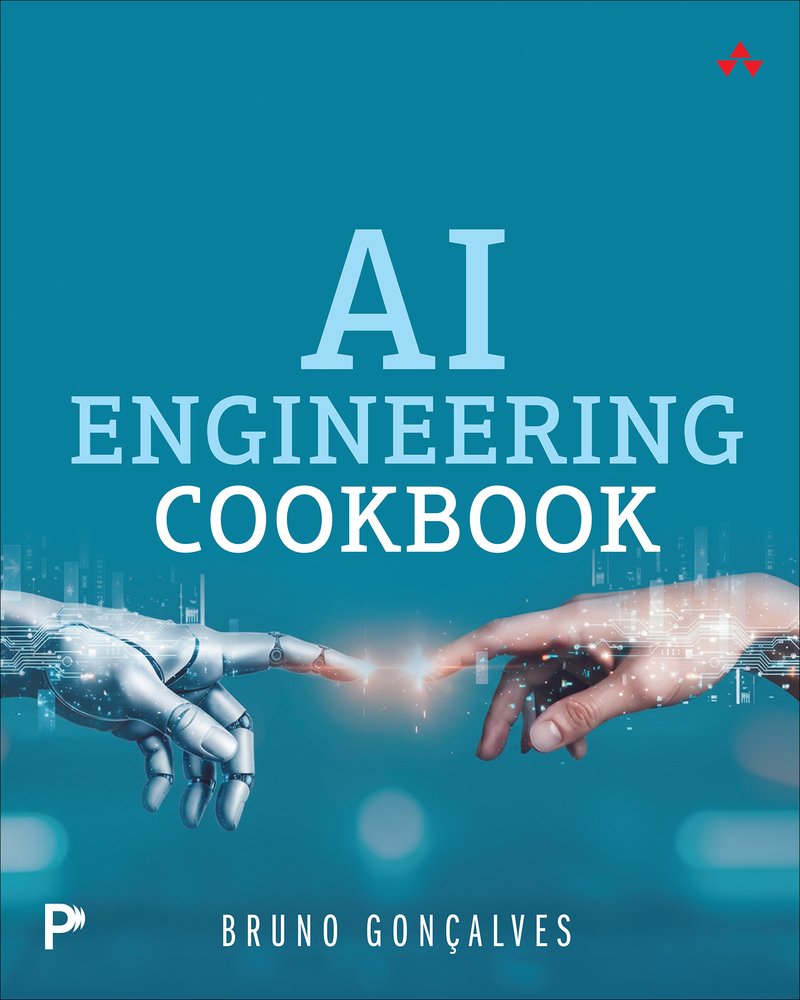
Good news, everyone! We're proud to announce that our book is coming to a bookshelf near your in 2027!
The book is split into 18 chapters and each chapter is an individual project in Python for building an AI systems that actually hold up in production. Starting from single structured LLM calls and RAG workflows to evaluation harnesses, multi-agent systems, and fine tuning self-hosted open-weights models.
As always, everything is built from the ground up to run on a modern laptop and using only publicly available datasets.
Explore the full table of contents and get notified when pre-orders open
And if you're interested in this topic, don't forget to register to the Data for Science substack where we cover how to use LLMs in detail!
Dear Reader,
Welcome to the Thanksgiving edition of the Data Science Briefing. At Data For Science, we’re wishing everyone a wonderful turkey day surrounded by family and loved ones.
AI labs lack a shared unit for progress, and one lab’s chief scientist nominates perplexity. A model with low perplexity guesses the next token well. The lab’s scores fall from about 0.99 for GPT-3.5 to 0.76, the level where new math results arrived. The essay asks every lab to hold shared limits until monitoring improves, but it names no number. Economics research faces its own test. A Zurich project had AI write 1,000 policy papers, and 842 carried severe errors. One in ten peer-reviewed papers from the top five journals had a grave error too. The data series teaches the method behind today’s reasoning models. On a 500-state taxi task, Q-learning lifts the return from about -345 to -168.24. A dueling double DQN then balances a pole for an average return of 45.80, against 25.22 for random moves. Not everyone trusts the labs to keep such a promise. A three-sentence open statement accuses Anthropic of racing to build the self-improving AI it warns against. A computer scientist doubts that superintelligence is buildable at all and calls the chase “an act of clear negligence”. A neuroscientist ties consciousness to living bodies, not to code. No one gets wet in a simulated storm. So why do the labs keep building? Markets reward the bet, a long lecture argues. In early 2021, the stock market priced a dollar of Tesla profit at about $600. A dry cleaner gets $1 for the same dollar.
Data shows that the best way for a newsletter to grow is by word of mouth, so if you think one of your friends or colleagues would enjoy this newsletter, go ahead and forward this email to them. This will help us spread the word!
Semper discentes,
The D4S Team
This weeks book is "Co-Existence: The Next Phase of AI" by Ethan Mollick. In 2022, forecasters gave AI a 2.3% chance of Math Olympiad gold by 2025. Google and OpenAI both won gold in 2025. Ethan Mollick builds his new book on that miss. The Wharton professor’s sequel to Co-Intelligence runs 240 pages. Its subject is daily life beside smart but erratic machines. Mollick writes for general readers, but model builders will find plenty worth stealing.
Chapter 3 explains the jagged frontier with two ideas. Emergence means one fixed weak link brings a sudden jump in skill. Transcendence means a model trained on many people beats each of them. Both terms help with managers who expect smooth progress. The Bitter Lesson section shows GPT-4 beating the finance-trained BloombergGPT on financial tasks. Any team pricing a custom domain model should read it. The book swaps prompt tricks for context engineering. In one negotiation study, instruction differences explained 73% of the variation in outcomes. Chapter 7 brings the O-Ring theory to AI at work. Speed up one link, and the bottleneck moves. One early 2025 study found 75% of engineers using AI tools, with zero correlation to deployment frequency. Chapter 10 shows models misreporting their own reasoning. A model’s self-report is a lead, not a fact.
The chapters on work speak to anyone who ships models. Mollick keeps his Centaur and Cyborg modes from the first book. He adds a third mode, the Conjurer. You hand an agent a whole project and judge the output. The book skips the setup work behind that judgment. Eval sets and test harnesses take weeks to build. Data scientists do that work every day, and the book leaves that chapter to them. Skim Chapter 3. Read Chapter 7 ahead of your next planning meeting. Then ask where your team’s weakest link sits.
• A Society of AI Scientists (Rehaan Ahmad, Myles Anderson, Ao Qu, Mars Gao, Yubin Kim, Josiah Aklilu, Alfonso Amayuelas, Summer Eunhyung Ann, Riccardo Cadei, Sajib Acharjee Dip, Nadim Farhat, Akash Haridas, Shih-Cheng Huang, Yukun Huang, Zhihan Jiang, Lars Benedikt Kaesberg, Art Kanke, Daniel Kim, Bo-Han Lai, Kayla Leung, Jianping Li, Zhanzhao Li, Kazi Mehrab, et al)
Google DeepMind's Demis Hassabis: How AI could become dangerous (with Reid Hoffman)